↓
 

Huntsville Brick Stone

Brick & Stone Masons in Huntsville, AL

Huntsville Brick Stone
  • Home
  • Brick Masonry
  • Stone Masonry
  • Indoor Fireplaces
  • Outdoor Fireplaces
  • Custom Tile Showers
  • Retaining Walls
  • Gallery
Home→Categories Brick Mason - Page 7 << 1 2 … 5 6 7 8 >>

Category Archives: Brick Mason

Post navigation

← Older posts
Newer posts →

Brick Fireplace Repair vs Replacement: What You Should Know

Huntsville Brick Stone Posted on July 10, 2026 by HuntsvilleBSJuly 2, 2026
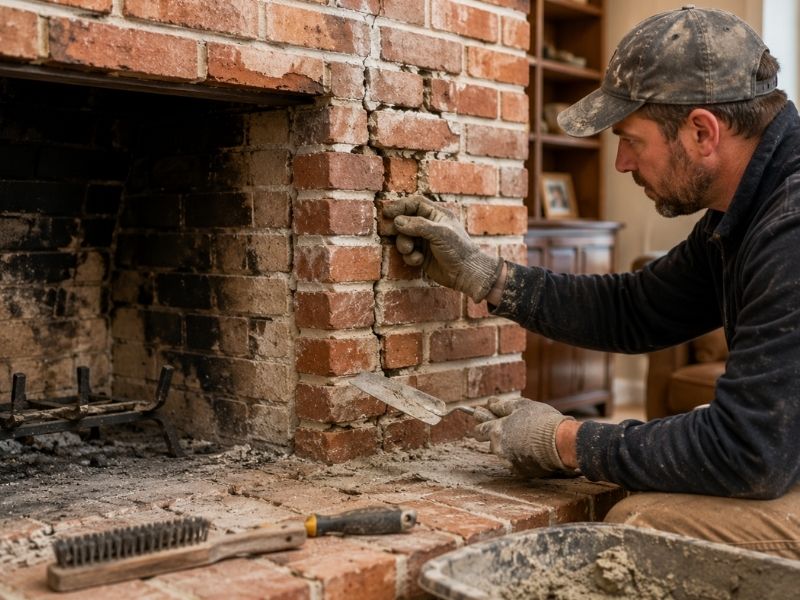
Mason inspecting and repairing cracked mortar on a brick fireplace in Huntsville, Alabama to determine whether the fireplace needs repair or full replacement.

A cracked brick fireplace doesn’t always mean a full rebuild. Sometimes it means a $400 repointing job. The trouble is telling the two apart before you’ve already spent money guessing.

This matters for developers weighing renovation budgets or advising clients on an older home. Get the call wrong and you either overspend on an unnecessary rebuild or underspend on a fireplace that needed to come down. Here’s how to tell which one you’re actually looking at.

How to Determine If Brick Fireplace Damage Is Surface-Level or Structural

Not every crack means trouble. The first step is figuring out whether damage sits on the surface or runs deeper into the structure.

A proper evaluation often follows a masonry repair decision framework, where the condition of the brick, mortar, and overall alignment is assessed before deciding whether repair or replacement is necessary.

Surface-level damage usually looks like:

  • Thin cracks in mortar joints that don’t affect brick alignment
  • Soot staining or discoloration from normal use
  • Minor spalling (flaking) on individual brick faces

Structural damage usually looks like:

  • Bricks that have visibly shifted out of alignment
  • Gaps wide enough to see daylight through, in a chimney context
  • Cracks that run through the brick itself, not just the mortar
  • A firebox that feels loose or unstable when touched

A quick way to check: press gently on the brick near a crack. Surface issues stay put. Structural issues shift, even slightly, under light pressure.

Common Brick Fireplace Problems That Can Be Safely Repaired

Most fireplace problems fall into the repairable category, especially if they’re caught early.

Mortar Wear and Repointing

Mortar breaks down faster than brick, especially near a firebox where heat cycles stress the joint constantly. Repointing (removing old mortar and packing in new) is a standard fix and doesn’t require touching the brick itself.

Hairline and Minor Cracks

Small cracks that don’t affect structural alignment can usually be filled and sealed. This is common on fireplace faces that see a lot of heat exposure but no real load-bearing stress.

Spalling Brick Faces

When individual bricks flake or pop on the surface, often from moisture or excess heat, they can typically be replaced one at a time without disturbing the surrounding wall.

Minor Efflorescence

White, chalky deposits from moisture movement are usually cosmetic and can be brushed off and addressed with better ventilation or moisture control, not a rebuild.

Warning Signs That a Brick Fireplace Has Reached Replacement Stage

Some damage goes past what repair can fix. These signs point toward replacement instead of patching.

  • Multiple bricks are loose or missing, not just one or two isolated spots
  • The firebox has separated from the surrounding wall, creating a visible gap
  • Cracks run consistently through brick and mortar together, not just along joints
  • The chimney leans or has visibly shifted from its original vertical line
  • Previous repairs have already failed, meaning the underlying cause was never fixed

That last point matters more than people expect. A fireplace that’s been patched two or three times for the same crack usually has a root cause, like water intrusion or foundation movement, that repointing alone won’t solve.

Cost and Risk Differences Between Repairing and Rebuilding a Fireplace

Repair costs stay low because the work is localized. Rebuilding costs climb fast because it touches the whole structure, plus removal and disposal of the old materials.

FactorRepairRebuild
Typical cost rangeLower, project-specificSignificantly higher
TimelineDays1-2 weeks or more
Risk if underlying cause is unaddressedRepair may fail againRoot cause typically resolved during rebuild
Best fitCosmetic or isolated structural issuesWidespread or repeated structural failure

The risk with repair isn’t the repair itself. It’s choosing repair when the real problem is bigger than what’s visible. A mason who checks for root cause before recommending repair saves money in the long run, even if the initial quote looks higher than a quick patch job.

How Masonry Condition and Age Influence Repair vs Replacement Decisions

Older fireplaces don’t automatically need replacement, but age changes the math. Brick and mortar both degrade with heat cycling, moisture exposure, and time. A 60-year-old fireplace with well-maintained mortar can outlast a 20-year-old one that’s been neglected.

What actually matters more than age alone:

  • How consistently the fireplace has been maintained
  • Whether the original construction used quality materials and proper technique
  • How much heat and moisture exposure the structure has taken on over time
  • Whether previous repairs addressed root causes or just symptoms

A developer evaluating an older property should treat fireplace age as one data point, not the deciding factor. A well-built, well-maintained older fireplace can be a better bet than a newer one with a history of skipped maintenance.

Frequently Asked Questions

How can I tell if fireplace cracks are dangerous?

Cracks that run through the brick itself, cause visible shifting, or allow daylight to pass through a chimney are signs of structural risk. Thin mortar-only cracks without movement are usually cosmetic.

Is repointing a fireplace expensive?

Repointing is typically one of the more affordable fireplace repairs because it replaces only the mortar, not the brick itself. Cost depends on how much of the structure requires new mortar.

Can a fireplace be repaired more than once?

Yes, but repeated repairs in the same area usually indicate that the root cause was never addressed. If a crack keeps returning, it may point to water intrusion or structural movement rather than surface damage.

How long does a well-maintained brick fireplace last?

With proper upkeep, a brick fireplace can last 50 years or more. However, poor maintenance, water exposure, or low-quality original construction can significantly shorten its lifespan.

When is rebuilding the safer choice over repair?

Rebuilding becomes the safer option when multiple bricks are loose, the structure has visibly shifted, or previous repairs have failed. In these cases, repeated repair often only delays a larger structural issue.
Posted in Brick Mason | Tagged Brick, fireplace masonry

Why Brick Masonry Fails Faster on Homes With Poor Drainage

Huntsville Brick Stone Posted on June 24, 2026 by HuntsvilleBSJune 24, 2026
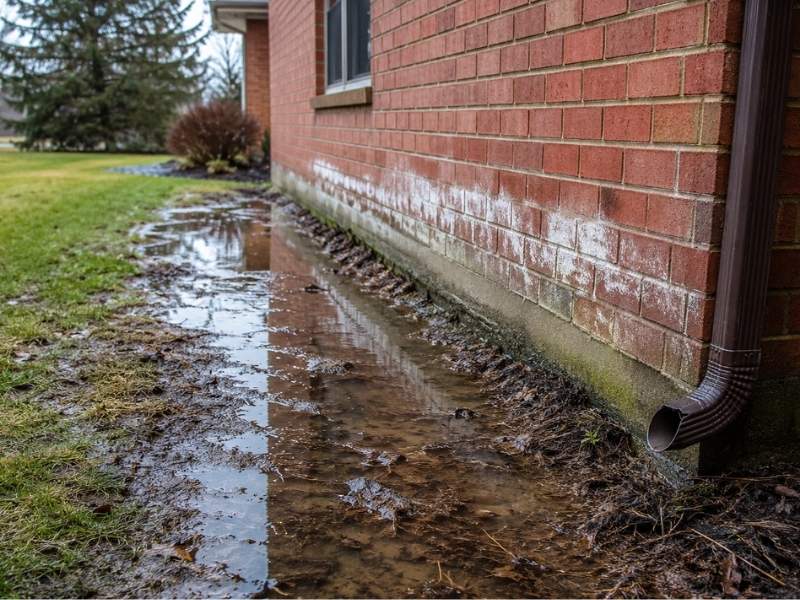
Brick masonry wall beside a home showing moisture staining and water pooling caused by poor drainage near the foundation

Brick has a reputation as the material you install once and forget. It’s supposed to last a hundred years with no fuss. On a lot that drains badly, brick masonry can start breaking down in a fraction of that time. Ground moisture climbs up from the wet soil, a problem known as rising damp in brick walls, and the bottom of the wall never gets to dry out. The brick didn’t change. The water around it did. For developers, the lesson is simple. The grading and drainage you set during site work decide how fast the brick on top of it wears out. 

What Actually Makes Brick Fail Faster

Brick takes on water and dries out again. That’s normal. Good brick handles that wet-and-dry rhythm for decades.

The problem starts when the brick never gets to dry. Poor drainage keeps the soil at the base of the wall soaked. Water sits there, and the brick stays wet most of the time. Now every damage event hits a wall that’s already saturated, with no time to recover between hits. That’s the real reason drainage decides the timeline. The damage comes from moisture that sits and never drains away.

How Ground Water Climbs Into the Wall

Brick is full of tiny pores. When the soil at the base stays wet, those pores pull water upward, the same way a paper towel pulls up a spill. Masons call this rising damp. The wetter the ground, the higher the water climbs.

This is why flashing and weep holes near the base matter so much. The Brick Industry Association says base flashing and weeps should sit no more than 10 inches above the finished ground. That detail blocks ground water from wicking up into the wall. On a wet lot with no break, the water just keeps rising and the lower courses stay soaked.

Why Constant Moisture Speeds the Damage

A wall that stays wet fails in three ways at the same time. Each one feeds the next. Together they shorten the wall’s life faster than any single problem would.

Salt builds pressure inside the brick

Ground water carries dissolved salts. As that water moves through the brick and dries near the surface, the salts crystallize. Those crystals grow and push outward. The pressure cracks the face of the brick and flakes pieces off. You see the white stains first, but the real harm is the force building inside.

Freeze and thaw hit a soaked wall harder

When wet brick freezes, the water inside expands and pries the surface apart. Brick that dried out would shrug this off. Brick held wet by bad drainage can’t. The more soaked the wall, the more likely it cracks and spalls each time the temperature drops. That’s why builders in colder zones spec severe-weather grade brick rated to freeze while wet.

Mortar joints wear out early

Mortar is the sacrificial part of a wall. It wears out before the brick does, on purpose. Constant moisture softens and erodes those joints fast. Once the joints open up, even more water gets in, and the whole wall declines quicker.

The Drainage Choices That Set the Clock

This is the part developers control. Every mechanism above runs on standing water near the base. Move the water and you slow all of it down at once.

  • Grade the lot so the ground falls at least 6 inches over the first 10 feet away from the foundation. The IRC requires this for a reason.
  • Slope driveways, walks and patios within 10 feet of the wall at least 2 percent away from the building.
  • On soil that holds water, install a foundation drain with gravel, filter fabric and a pipe that runs downhill at a quarter inch per foot.
  • Discharge that water well away from the base, never back toward it.
  • Keep base flashing and weeps no more than 10 inches above the final grade so ground moisture can’t wick up.

None of this is exotic. It’s ordinary site work done right the first time, before the brick ever goes up. Get it right once and the wall stops fighting water for the rest of its life.

Why This Lands on Builders, Not Buyers

Drainage failures are patient. The lot looks fine at closing. The brick looks perfect on move-in day. The spalling and stained joints show up two or three winters later, long after the buyer signed. By then it’s a callback, a warranty claim and a hit to your reputation.

Grading a lot right costs little during site work. Tearing out and replacing failed masonry costs a lot, and it always lands on whoever built it. The brick will outlast the mortgage if the water has somewhere to go. That’s a site decision, and it’s yours to make.

Frequently Asked Questions

Does poor drainage really make brick fail faster, or does it just look worse?

It does real structural harm. The stains are only the surface of it. Constant wetness lets salt pressure, frost and joint erosion grind on the wall with no break, and that steadily shortens how long it lasts.

How far should the ground slope away from a brick home?

The ground should drop at least 6 inches within the first 10 feet of the wall. Hard surfaces like driveways and patios near the home should slope at least 2 percent away. This pushes rain away from the base instead of letting it pool.

What is rising damp in a brick wall?

Rising damp is ground water creeping upward through brick from wet soil below. The pores in the brick act like a wick. It often shows up as a damp, stained band along the lower part of the wall.

Can good quality brick still fail on a wet lot?

Yes. Even high-grade brick wears out early when it can’t dry between soakings. A tougher brick buys time, but it can’t beat water that has nowhere to drain. On a wet lot, the drainage decides more than the brick spec does.

Does every home need a foundation drain?

No. Lots with sandy, fast-draining soil often shed water on their own. Soil that holds water, like clay-heavy ground, usually needs a drain to move water away from the footing before it can rise into the wall.

Posted in Brick Mason | Tagged Brick, Brick Masonry

Brick Paver Patterns That Create a Timeless Look

Huntsville Brick Stone Posted on June 18, 2026 by HuntsvilleBSJune 16, 2026
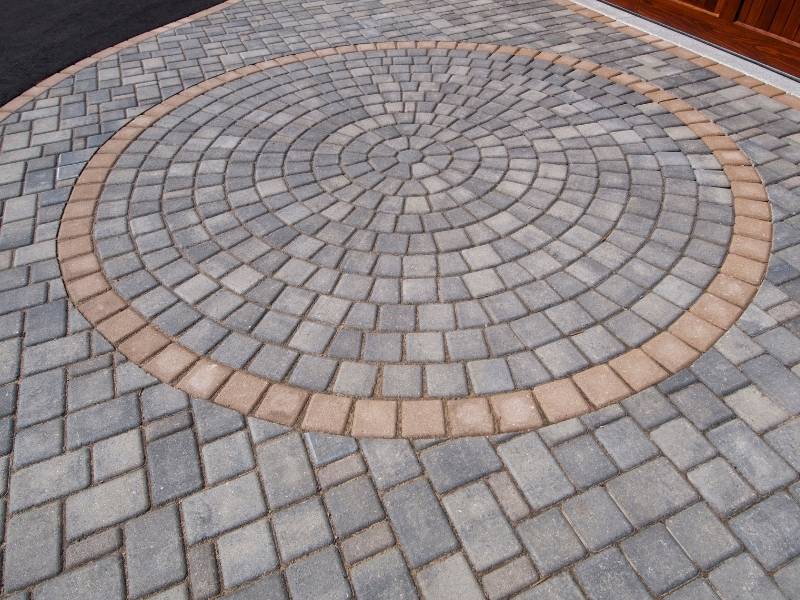
Circular brick paver pattern with contrasting borders creating a timeless look for a driveway or patio.

Most developers spend hours picking the right paver color. Then they pick a pattern in five minutes. That’s backwards.

The pattern is what people see. Color is secondary. Get the pattern wrong and the whole space feels off, no matter how expensive the material is.

Brick paver patterns that create a timeless look share one thing: they work with the geometry of the space, not against it. This article breaks down the top five patterns, when to use each one, and what drives up cost.

The Basics of Brick Paver Layout

Before picking a pattern, you need to know two things.

First, not all patterns work on all shapes. A herringbone looks great in a long rectangular path. It looks cluttered in a small, irregular courtyard.

Second, cut pieces cost money. Some patterns require a lot of cuts at the edges. Others don’t. That difference shows up in labor hours.

Pavers are typically laid on a compacted aggregate base with a sand setting bed. The base depth varies by load. Foot traffic needs less. Driveways need more. The pattern sits on top of this system. The base doesn’t change based on pattern, but the installation time does.

Brick Paver Patterns That Create a Timeless Look

Running Bond

This is the most common pattern. Each row offsets by half a brick. It’s the same layout used in standard brick walls.

Running bond works on almost any surface. Paths, patios, driveways. It’s simple to install, which keeps labor costs reasonable.

The visual effect is directional. It pulls the eye forward or across, depending on orientation. Use it to make a narrow space feel longer.

Herringbone

Herringbone is the strongest pattern structurally. The interlocking 45-degree or 90-degree angles distribute load across more contact points.

That’s why it’s the go-to for driveways and high-traffic areas. The pattern resists shifting over time better than most others.

Visually, it reads as active and detailed. It holds attention without feeling busy. A 45-degree herringbone on a diagonal to the house creates a sense of movement toward the entry.

Install time is higher. Cuts are frequent, especially at borders. Budget accordingly.

Basketweave

Two pavers laid horizontally, two laid vertically, repeating. It creates a woven texture that reads as classic and residential.

Basketweave suits patios and low-traffic areas well. It’s not the best choice for driveways because it lacks the interlocking strength of herringbone.

The look is soft. It pairs well with traditional architecture. If the building style is formal or colonial, basketweave fits without conflict.

Pinwheel

Four pavers arranged around a single center paver. The result is a square repeat with a lot of visual interest.

This pattern works best as an accent, not a field pattern across a large area. Use it in a courtyard center, around a feature, or as a border inset.

Full pinwheel across a large driveway gets visually noisy fast. Restraint here pays off.

Stacked Bond

All joints align in both directions. Rows stack perfectly on top of each other.

Stacked bond is the most modern-looking option on this list. It reads as clean and geometric. It suits contemporary and minimalist architecture well.

One warning: stacked bond is structurally weaker than running bond or herringbone. The aligned joints create continuous lines through the surface. Under shifting soil or heavy load, those lines crack first.

Use it on patios and decorative walks. Avoid it on driveways unless the base is very well prepared.

How Pattern Choice Affects Project Cost

Pattern complexity drives labor cost more than material cost.

Running bond is the cheapest to install. Fewer cuts, predictable layout.

Picking the Right Pattern for the Space

Match the pattern to the use case first. Then match it to the architecture.

Driveways: Herringbone at 45 or 90 degrees. The structural performance justifies the cost.

Pool decks and patios: Running bond or basketweave. Both drain well and hold up under foot traffic without the premium install cost.

Entry walks: Running bond oriented toward the door pulls visitors forward. Herringbone at 45 degrees adds formality.

Accent areas: Pinwheel. Keep it contained.

Modern architecture: Stacked bond on patios and decorative areas. Avoid on high-load surfaces.

Scale matters too. On large surfaces, a complex pattern can feel overwhelming. Simple patterns read better at scale. Complex patterns work well in smaller, defined areas where the detail has room to register.

Frequently Asked Questions

What brick paver pattern lasts the longest?

Herringbone is the most durable pattern for high-traffic surfaces. The interlocking angle distributes load across more pavers, reducing shifting and cracking over time. For driveways, it’s the standard recommendation among professional installers.

Which paver pattern is easiest to install?

Running bond is the simplest. It requires fewer cuts and follows a predictable layout. It’s the best starting point for residential patios and walkways where labor cost is a concern.

Can you mix paver patterns in one project?

Yes. A common approach is using running bond for the main field and adding a herringbone or pinwheel border. The key is using a soldier course (a single row of pavers laid perpendicular) as a transition between patterns.

Do paver patterns affect drainage?

The pattern itself doesn’t change drainage significantly. Joint width and base preparation matter more. Wider joints allow more water infiltration. Permeable paver systems use open graded bases specifically for stormwater management.

What paver pattern works best for a modern home?

Stacked bond suits modern and minimalist architecture. The aligned joints read as clean and deliberate. Pair it with large-format pavers in a light gray or charcoal tone for a sharp, contemporary look. Avoid stacked bond on driveways due to structural limitations.

Posted in Brick Mason | Tagged Brick

Post navigation

← Older posts
Newer posts →

Leave a Review on Google

Leave a Google Review

Leave a Review on YELP

Leave a Yelp Review

Leave a Review on Facebook

Leave a Review on Facebook

CONTACT US

© Copyright 2021 Huntsville Brick & Stone
​​​​Huntsville, Alabama ​35803
Phone: (256) 804-0025

Privacy Policy | Terms of Use

Web Development and SEO by:
Southern SEO

↑